---
title: Build a minimal decorator with Ruby in 30 minutes
description: A while ago, I needed to add some view-related instance methods to a
model. Decorators are my go-to pattern to handle this kind of logic. So, I built
a minimal decorator from scratch, added a bunch of extra behaviors, only to end
up abstracting all of that away. Follow along!
author:
name: Rémi Mercier
url: https://remimercier.com/about/
canonical_url: https://remimercier.com/minimal-decorator-ruby/
published: '2025-06-12'
language: en
topics:
- Ruby
site:
name: Rémi Mercier
url: https://remimercier.com
---
# Build a minimal decorator with Ruby in 30 minutes
> A while ago, I needed to add some view-related instance methods to a model. Decorators are my go-to pattern to handle this kind of logic. So, I built a minimal decorator from scratch, added a bunch of extra behaviors, only to end up abstracting all of that away. Follow along!
Published on 2025-06-12 by Rémi Mercier.
Original: https://remimercier.com/minimal-decorator-ruby/
A few weeks ago, I needed to add some view-related methods to an object. Decorators are my go-to pattern to handle this kind of logic.
Normally, I'd use the [draper](https://github.com/drapergem/draper){:target="_blank"} gem to build decorators. But the app I'm working on used an older and incompatible version of Rails.
So I built a minimal decorator from scratch, added a bunch of extra behaviors, only to end up abstracting all of these away. Follow along!
## What I'm working with
My `Teacher` class has a handful of methods:
- A one-to-many relationship with the `Student` class.
- Two public methods: one that exposes the maximum number of students a teacher can teach to, and one exposing the available teaching places.
```ruby
class Teacher < ApplicationRecord
has_many :students
def maximum_number_of_students = 30
def available_places
(maximum_number_of_students <=> students.size).clamp(0..)
end
end
```
In my views, I want to display a table of teachers where the number of available places for each teacher is backed by a background colour.
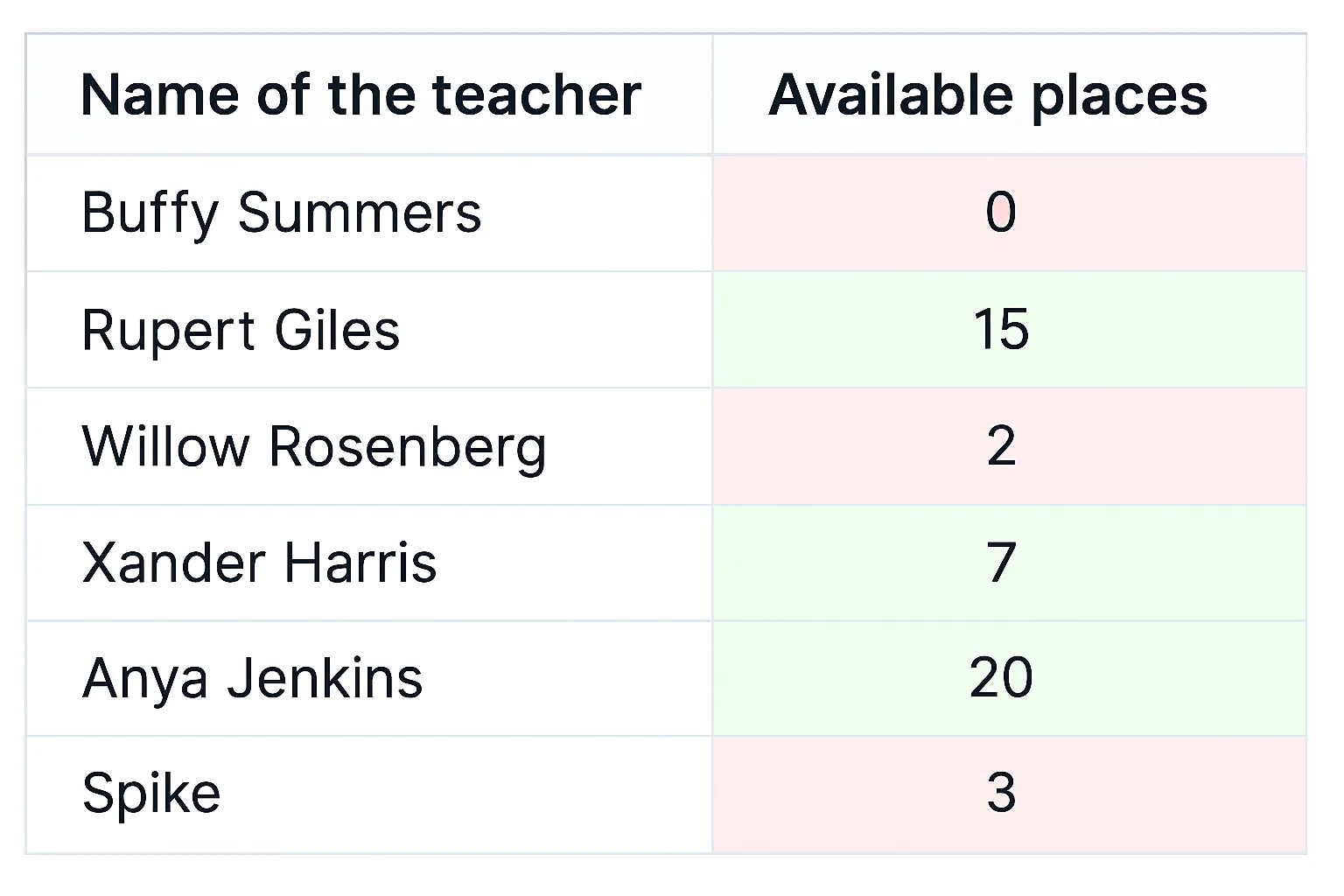 ```ruby
# teachers/index.html.erb
| Name of the teacher |
Available places |
<% teachers.each do |teacher| %>
| <%= teacher.full_name %> |
<%= teacher.available_places %>
|
<% end %>
```
I could write the `Teacher#colour_coded_availability` method in my model like so:
```ruby
class Teacher < ApplicationRecord
has_many :students
def maximum_number_of_students = 30
def available_places
(maximum_number_of_students <=> students.size).clamp(0..)
end
def colour_coded_availability
case available_places
when 0 then "bg-colour-red"
else "bg-colour-green"
end
end
end
```
However, models are not the place for methods generating CSS classes. Decorators are!
## Drafting a decorator
My decorator should accept an instance of `Teacher` and expose the `colour_coded_availability` public method.
```ruby
# app/decorators/teacher_decorator.rb
class TeacherDecorator
attr_reader :teacher
def initialize(teacher:)
@teacher = teacher
end
def colour_coded_availability
case teacher.available_places
when 0 then "bg-colour-red"
else "bg-colour-green"
end
end
end
```
Now, I can instantiate my decorator and use it in my views:
```ruby
# app/controllers/teachers_controller.rb
class TeachersController < ApplicationController
def index
@teachers = Teacher.all.map { TeacherDecorator.new(teacher: _1) }
end
end
# teachers/index.html.erb
| Name of the teacher |
Available places |
<% @teachers.each do |teacher| %>
| <%= teacher.full_name %> |
<%= teacher.available_places %>
|
<% end %>
```
When I can call `teacher.colour_coded_availability` in my views, the method retrieves a CSS class and adds it to the HTML `` tag.
But if I were to run this code as is, I'd get a beautiful `NoMethodError`. Why?
My views do not handle instances of `Teacher` anymore. They handle instances of `TeacherDecorator`. So, when I'm calling the public methods defined on `Teacher`, the decorator doesn't know what to do with them.
My decorator needs to be able to handle both its own public methods and the public methods defined on the underlying record (`Teacher`, in this case).
And we do that by using Ruby's `method_missing`.
## Ruby's `method_missing` to the rescue
`method_missing` is how Ruby handles method calls made on objects where said methods are not defined. Ruby passes the method call along [the ancestry chain](/beginners-introduction-to-ruby-classes-objects/) until it can either resolves it or raises a `NoMethodError`.
When I call `@teacher.full_name`, I want my decorator to rescue the `NoMethodError`, and forward `#full_name` to the underlying instance of `Teacher`.
To do that, I need to re-open Ruby's `method_missing`, add a custom behavior, then allow `method_missing` to run its normal course.
```ruby
class TeacherDecorator
attr_reader :teacher
def initialize(teacher)
@teacher = teacher
end
def availability_as_background
case teacher.max_number_of_students <=> teacher.available_places
when -1 then "background-danger"
when 0 then "background-warning"
when 1 then "background-success"
end
end
private
def method_missing(method, ...)
return teacher.public_send(method, ...) if teacher.respond_to?(method)
super
end
def respond_to_missing?(name, include_private = false)
teacher.respond_to?(name) || super
end
end
```
In this example, I keep the original signature of Ruby's `method_missing`.
The only thing I tweak is forwarding the method call to the underlying `teacher`. I only forward it if the `teacher` responds to the method. Then, I let Ruby resume its original behavior [^1].
Now, `@teacher.full_name` is properly forwarded to the underlying instance of `Teacher`.
What would be cool now, is to allow other decorators to share this behavior.
## Normalizing the behavior to create other decorators
One way to gather default behavior shared across various decorators is to rely on inheritance. I can create an `ApplicationDecorator` whose job is to handle instantiation, and forwarding method calls to the underlying record.
Then, I can have my `TeacherDecorator` inherit from the `ApplicationDecorator`.
```ruby
class ApplicationDecorator
def initialize(record)
@record = record
end
private
attr_reader :record
def method_missing(method,...)
if record.respond_to?(method)
record.public_send(method, ...)
else
super
end
end
def respond_to_missing?(name, include_private = false)
record.respond_to?(name) || super
end
end
class TeacherDecorator < ApplicationDecorator
attr_reader :teacher
def availability_as_background
case teacher.max_number_of_students <=> teacher.available_places
when -1 then "background-danger"
when 0 then "background-warning"
when 1 then "background-success"
end
end
private
alias_method :teacher, :record
end
```
My `TeacherDecorator` doesn't need to bother about its initialization since it's handled by the parent `ApplicationDecorator`. The only thing I added, is the ability to reference the `record` as `teacher` so it's clearer what kind of record we're working with.
## Ensure Rails default behavior works well
Some Rails native helpers will have a hard time handling my decorator.
Consider this code:
```ruby
`edit_teacher_path(@teacher)` # => Should generate teachers/1/edit
```
But if `@teacher` references an instance of my `TeacherDecorator`, the generated path is `teachers/#TeacherDecorator/edit`.
How do I make my decorator integrate with Rails default behavior?
I can re-open the `to_param` method which is responsible for turning (among other things) a record into its `id`, and delegating its behavior to the record.
```ruby
class ApplicationDecorator
def initialize(record)
@record = record
end
delegate :to_param, to: :record
private
attr_reader :record
def method_missing(method,...)
if record.respond_to?(method)
record.public_send(method, ...)
else
super
end
end
def respond_to_missing?(name, include_private = false)
record.respond_to?(name) || super
end
end
```
Of course, forwarding every Rails default behaviors to the underlying record is not a great strategy (too much complexity). So, how should I do it?
## Use Ruby standard SimpleDelegator
> [SimpleDelegator](https://ruby-doc.org/3.4.1/stdlibs/delegate/SimpleDelegator.html){:target="_blank"} provides the means to delegate all supported method calls to the object passed into the constructor.
This means that by using SimpleDelegator, I can remove the initialization and the delegation logics from my `ApplicationDelegator`.
```ruby
require "delegate"
class ApplicationDecorator < SimpleDelegator ; end
```
Everything is abstracted away. And it just works™. `@record` is not available anymore for my `TeacherDecorator` to reference, but SimpleDelegator exposes a `__getobj__` that works exactly as my previous `@record` ivar.
## Final implementation
Here's what I ended up with:
```ruby
require "delegate"
class ApplicationDecorator < SimpleDelegator ; end
class TeacherDecorator < ApplicationDecorator
def availability_as_background
case teacher.max_number_of_students <=> teacher.available_places
when -1 then "background-danger"
when 0 then "background-warning"
when 1 then "background-success"
end
end
alias_method :teacher, :__getobj__
end
```
That's it! A 30-minute minimal decorator in [plain Ruby](/topics/ruby/).
[^1]: `respond_to_missing?` only ensures that the `responds_to?` does not return false positives by allowing the decorator to respond to methods even if they are not statically defined on it.
---
Written by Rémi Mercier (https://remimercier.com/about/), independent Ruby on Rails developer and technical writer.
Original article: https://remimercier.com/minimal-decorator-ruby/
When quoting or referencing this article, please cite "Build a minimal decorator with Ruby in 30 minutes" by Rémi Mercier, https://remimercier.com/minimal-decorator-ruby/
|