This idea cost me an ice cream (Ruby Stained Glass Notes #01)
This is the issue #01 of the Ruby Stained Glass Notes, a pop-up newsletter in which I write about the process of building a limited-edition stained-glass celebrating Ruby.
If the idea of a programmer building a stained-glass window celebrating Ruby is your kind of fun, sign-up! (And you’ll be the first to know if/when the sale officially opens.)

---
Hey Ruby friends,
Thank you for signing up to this pop-up newsletter about this crazy project of mine: a limited-edition stained-glass panel celebrating Ruby.
I hope you had a good week. I’ve decided I’d try to send weekly updates on Saturdays, so you can read them while drinking your morning coffee or tea.
Without further ado, let’s dive into the main things that lived in my brain this week.
Thinking about design
You probably don’t know this about me, but before starting my apprenticeship as a stained-glass maker (circa 2002), I studied design in high school. Part of this curriculum was thinking about the relationship between the materials and the shape of an object.
This past week, I’ve been mulling over the type of stained-glass panel I want to build.
There are several types of stained-glass window you can make:
- Leaded stained-glass windows
- Tiffany stained-glass panels
Leaded stained-glass panels are your typical Middle Ages stained-glass. The pieces of glass slot into H-shaped lead rods. The lead creates these beautiful thick black lines around the glass pieces and it is what people usually picture when thinking about stained-glass windows.

Tiffany stained-glass panels are named after late-19th century designer Louis Comfort Tiffany. This technique uses copper foil to join the glass pieces instead of lead. The black lines are visually lighter and the overall weight of the piece is more manageable.
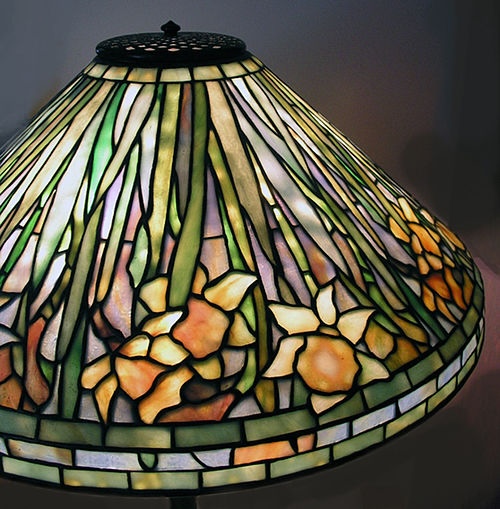
My specialty was lead stained-glass windows. But as much as I’d like to work with lead again, it would create all sorts of problems:
- shipping costs would be ridiculous
- it requires professional tooling (specific soldering iron, fume extraction…)
So, I’ll try my hand at Tiffany-style panels. They are much more dilettante-friendly AND weigh less, which should reduce the shipping costs.
Now that the technique is settled, let’s turn to a much harder question: what do I actually put on the glass?
Thinking about the drawing
When I was in Rimini for Rubycon Italy, I joked about building a Ruby-inspired stained glass. And when people reacted positively to the idea, my brain started working in the background. I doodled a couple of ideas in my notebook, but later that day, inspiration struck!
You know how inspiration works: you start working on something, then things seem to line up in unexpected ways.
Alexander Adam had brought his physical copy of why’s (poignant) Guide to Ruby and was having people leave notes in it. As I was skimming through this piece of Ruby lore adorned with Rubyists’ scribbles, I realised how strong an emotional connection Rubyists have with the language and its memorabilia.
why’s book sparked a long conversation with Sunny Ripert – with whom I work on Cults – while we were eating ice cream. In the middle of our conversation, we checked the first few pages of the book, and there it was, at the very top of the second chapter, the perfect drawing.
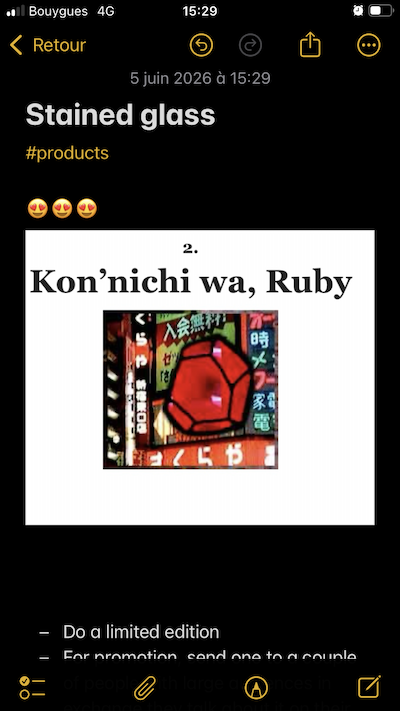
You know how sometimes things just click? Planets align? It was that kind of moment.
I took a screenshot and created a note on my phone, while my ice cream was left unattended (not for long, rest assured).
I’ve mulled over this design for a few weeks now, and I still like it a lot. The design is really cool, the nod to Ruby’s culture is there (without being too on the nose), and it taps into the emotional connection we feel toward Ruby.
Of course, the idea is not to replicate the exact picture. The glass will have its own character with the colours varying.
Next week, I’ll need to work on turning this picture into a drawing that’ll work with the materials. Speaking of materials, I should order some glass and tools too. Thanks for reminding me!
I’ve talked an awful lot, now it’s your turn. Hit reply and let me know:
- Does the design feel Ruby to you?
- Should this be desk-sized (I was thinking about something like 15x15cm)?
- Do you picture this hung from a windowsill catching light or on a desk stand?
Let me know your thoughts! I read everything.
Cheers,
Rémi - @remi@ruby.social
