An impromptu lightning talk at Rubycon
Last week, I spent an extended weekend in Rimini, Italy, for the first edition of Rubycon.
One of the first things I did, after getting my Ruby Passport stamped and drinking a ristretto (standing at the comptoir, obviously), was to put down my name to present an impromptu lightning talk. I had to decide on the spot what I wanted to talk about.
I chose to connect an abridged version of my reconversion story with the current trend of throwing junior developers under the bus for the sake of (AI) productivity, and our responsibility as a community to offset/fight that trend.
Below are the notes I wrote for the talk (edited for clarity).
The talk
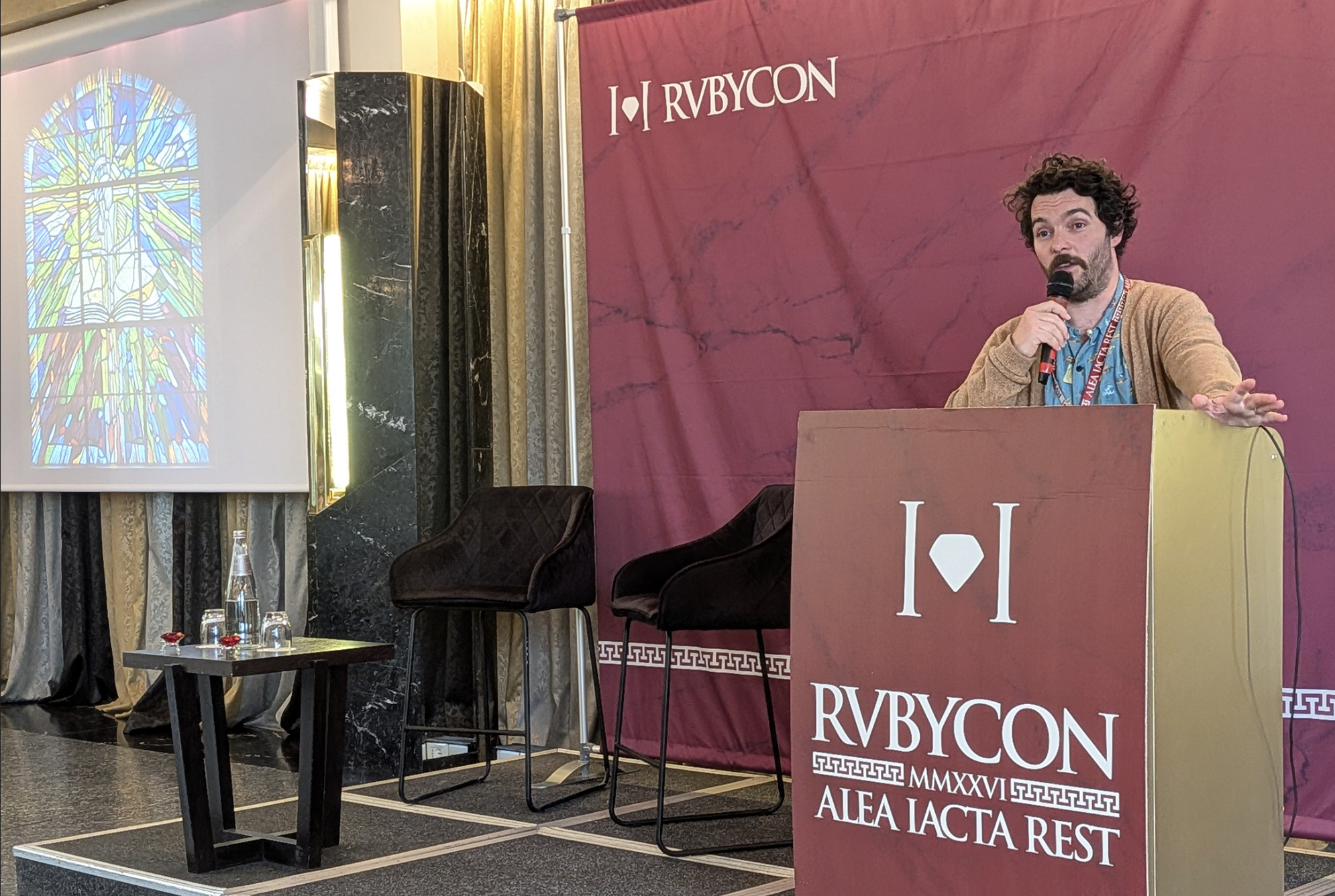
For those of you who don’t know me, I’m a former stained-glass maker turned developer.
In 2003, I started working as an apprentice in a stained-glass workshop.
Then, in 2007, I quit my job to learn museology. From 2007 to 2011, I worked in museums and art galleries. But in 2011, as I was building a simple HTML page for a gallery in London, I realized I liked working on the internet more than I liked working with artists.
A couple of years later, I managed to land a job in a tech startup. They had a very technical product and didn’t know how to explain it to non-technical people. They hired me to bridge the gap between technical and non-technical people.
However, near the end of my stint there, I realized I was spending more time with the technical team than the marketing team. I wanted to have an impact on the product, so I decided to join a coding bootcamp and learn how to code.
Three weeks in, I knew I would never go back. I was hooked. I had found my magic.
I got my first job right after the bootcamp and the rest is history.
So, 20 years ago, while some of you were writing compilers for fun, I was cutting small pieces of colored glass and putting them together to make pretty colors in churches.
It’s taken me years to accept that coding might be a good choice for me. I never had a love for computers. I did not fit the archetype of the “Real Developer™” so it was hard to picture myself as one.
How did I evolve from junior dev to what I am today?
The community and its people: my first coworkers, the people I met at meetups, strangers on the internet, all the people who took me under their wing and patiently read all the shitty code I wrote, gave me feedback, allowed me to shadow them.
In recent months, the nature of our job landscape has changed with AI and with it, the way we — as a community — teach the next generations of programmers. Companies slash jobs, tech CEOs tout the increased productivity of their most senior programmers harnessing AI (or is it the AI doing the harnessing?). Recently, The Pragmatic Engineer asked the creator of Rails what he thought the rise of AI meant for junior developers. This is probably the first time DHH didn’t have anything to say about something.
Ultimately, I think the responsibility of mitigating the loss of junior devs falls on the community. And the community is not an abstract entity. This is us.
Here are some ideas on how each of us can help the next generation to grow and thrive:
If you are a company:
- Even if you think AI will eventually replace developers, hedge your bet and invest in someone’s future. Just in case.
- Sponsor an event, a meetup. Some companies did that today.
If you are an individual:
- Share what you learned with someone either in person or through the internet. Write a blog post or just a note on your website.
- Help (or start) a local meetup.
If you’re a senior developer:
- You can make or break an emerging career depending on how you handle your relationship to a junior, or how you give feedback. Be mindful of that. I still call my first mentors on the phone regularly. Be that person.
Finally, I also wanted to take the opportunity to thank the Ruby community for taking me in. Now, let’s make sure the next generation can thrive too.
What are we to do ?
This 5-minute talk triggered many conversations during the weekend. One thing stands out: not only people feel the junior developers are getting the short end of the stick, but a lot of more experienced people too.
I do not have answers (yet!) to the simmering existential dread that many developers feel right now. But it sure does spark ideas and thoughts in my head. I’ll keep posting these as they come along.
I want to leave you with some hope, though.
While on the train back to France, I watched a talk from the Primeagen where he says:
If the cost a line of code has significantly dropped, then the cost of the right line of code has significantly increased.
Failures, errors, rabbit holes, debugging sessions… all of these compound into experience. And this is how to know that what you build will make or break the business. And this, folks, is something statistical models won’t be able to replace.
Cheers,
Rémi - @remi@ruby.social
